
Download The Chemistry of Evolution: The Development of our Ecosystem
And just how this book will help you? Do you believe that you have issue with similar subject? This is no stress over this. Also you have had the sources to address your troubles; this publication will finish just what you need. The Chemistry Of Evolution: The Development Of Our Ecosystem is just one of the books that that has been written by the trusted author. With the experience, understanding, and also facts that are offered by this book, it is really specialist.
The Chemistry of Evolution: The Development of our Ecosystem

Download The Chemistry of Evolution: The Development of our Ecosystem
Do you understand just what the advantages of analysis are? Before discussing concerning The Chemistry Of Evolution: The Development Of Our Ecosystem, we will ask you first. What do you obtain after checking out? What do you obtain after finishing reviewing a book? What's your feeling? Well, numerous inquiries we will certainly utter to you, the remarkable publication fan, and also visitors. We suppose you to be remarkable because in this contemporary age, many individuals prefer to talk with various other to reading. This is why, the reasons of exactly how the books must be cultured are necessary.
Waiting for launching this book is regardless of. It will not make you feel burnt out as exactly what you will really feel when awaiting someone. It will contain interest of just how this book is intended to be. When waiting a preferred book to read, one sensation that generally will take place is curious. So, what make you feel so curious in this The Chemistry Of Evolution: The Development Of Our Ecosystem
The reasons could not be big concepts for reviewing a publication to review when being in leisure. It will additionally not have to be so sensible in undertaking the life. When you have to most likely to the other areas and have no ideas to obtain the book, you can discover lots of soft documents of guide in the internet site that we show here. When it comes to obtaining the The Chemistry Of Evolution: The Development Of Our Ecosystem, you may not have to most likely to the book shop. This is the time for you to conserve guide soft documents in your device and afterwards bring it all over you will go.
Maintaining the behavior for reading is sometimes hard. There will certainly be lots of challenges to feel bored rapidly when reading. Lots of buddies might pick talking or going somewhere with the others. Checking out The Chemistry Of Evolution: The Development Of Our Ecosystem will make other individuals really feel that you are a really book enthusiast. Nevertheless, the one that reads this book will not always suggest as book lover.
Taking this publication is likewise very easy. Check out the link download that we have actually offered. You could feel so completely satisfied when being the participant of this online collection. You could also find the various other publication collections from worldwide. Once again, we here offer you not just in this type of The Chemistry Of Evolution: The Development Of Our Ecosystem We as give hundreds of guides collections from old to the brand-new updated book worldwide. So, you could not be afraid to be left behind by recognizing this book. Well, not just learn about guide, yet know what guide offers.
Book Description
A novel approach to uncovering the position of living organisms in a changing environment
Read more
Product details
Paperback: 494 pages
Publisher: Elsevier Science; 1 edition (December 31, 2005)
Language: English
ISBN-10: 9780444521552
ISBN-13: 978-0444521552
ASIN: 0444521550
Product Dimensions:
6.1 x 1 x 9.2 inches
Shipping Weight: 1.8 pounds (View shipping rates and policies)
Average Customer Review:
4.6 out of 5 stars
3 customer reviews
Amazon Best Sellers Rank:
#1,656,624 in Books (See Top 100 in Books)
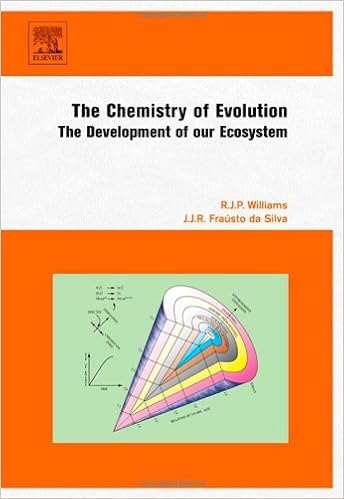
Combining chemistry with evolution might seem like a long, tedious exercise; it is anything but in this book. The authors do a masterful job of invigorating both topics. Their view of chemistry's structure of the Periodic Table for the appearance of life comes close to an Anthropic Principle for chemistry. The unique features of many elements besides carbon are shown to be critical to the origin of biological structures. "Again and again, we have to consider if these uses of elements in various mechanisms and pathways were the only possible ways for the system we call life to evolve, given environmental availability. The matching of function with the known chemical potentialities of the elements is extremely suggestive that there was but one effective way." (P. 173) Their treatment particularly of the metal elements and their importance alongside the organic elements, the usual suspects, is particularly instructive and eye-opening.But it is their view of evolution that is more compelling. The key is their concept of chemotype, analogous to genotype, but which captures biological development by chemical composition and energy usage and organization in ways that are common to many species. As an example, a large chemotype is all of the anaerobic bacteria or about the first billion years of evolution because they essentially used a similar chemistry or at least used the same set of elements. Similarly all of the multicellular animals are a chemotype because the palette of elements used, the energy uptake, and the organization form a distinct chemical category. Usually, chemistry is considered the underpinnings of biological organisms; in their formulation organisms and species are what compose chemotypes. Major chemotypes such as anaerobes, aerobic bacteria, eukaryotes, multicellular eukaryotes, etc. form sequences that find chemical-energy-organization solutions for particular environments or environmental eras and that come to depend on each other chemically so that they fit inside each other like Russian dolls (see cover drawing). Another advantage of their approach is that they are able to distinguish humans as a new chemotype even as they show the continuity of human activity with the progressive changes between earlier chemotypes. This picture of our uniqueness within continuity at least comes closer to the observed wild differences between us and great apes than does the conventional genetic picture.The book is readable and informative throughout even if beyond my background. They list in the credits two other earlier books on similar topics by themselves that show a long collaboration, and this book feels like a condensed, summary statement even at 450 pages. On the one hand I was surprised how engrossed they had me with things like the availability of molybdenum during evolution's oxidation phases or in what it could do in enzymes for particular reactions for particular organisms. On the other hand it was so refreshing to see science writers pushing beyond the particulars to grapple with the big picture. In their view evolution is unabashedly progressive.The authors are very aware that their view of evolution has let a genie out of the bottle of conventional Darwinism. In their words: "... much of evolution can be followed through gene sequences, but this discussion often appears as if it is an analysis of random events which dominates the selection of the `fittest' species. This leaves the impression that there is no rational explanation of the general development of life and to the limits of biological evolution towards ecological fitness. Our stance does not question that this description of the random origin of species is correct, we believe it is, but we consider that the species-embracing chemotypes and their divisions, which include very large groups of species in well-separated classes of organisms, have developed differently in an inevitable logical sequence forced by equilibrium thermodynamic environmental, and largely kinetically controlled life chemistry." (P. 307)They do a remarkable job of tying a huge array of research and ideas together into a provocative and convincing view of evolution. Very thought provoking.
This book is a delight to read, it is concise, straight to the point and its organization is impeccable. The authors start by stating why a biological evolution is inadequate and should be accompanied with the thermodynamics universal views. Settings that enable biomolecules formation is then described (biosphere). The theme of the book is that species evolution is a thermodynamics necessity to form energy efficient capturing and degradation systems, in which efficiency is rated as the system fitness. Thermodynamics biochem systems use substance in which are available to them and evolute through organization architecture engineering. The species evolution tree is then exposed by introducing to chemical changes (i.e. adding and discarding of substance usability and reactions). Human as the evolutionary epidome and its consequence is then analyzed.For me the settings that enable building blocks formation is not a starting point in biochem evolution, but a continuum. The two ultimate questions (1. the protocell origin, 2. dna coding) regarding cell were not answered--besides out of the thermodynamics necessity and efficiency--, my speculation is on coupled reactions within chemical species locality for the first and total ignorance for the later. It would be nice--although very difficult-- to approach the species evolutionary tree through an chemical inventory not just few differential observations. And finally, like most species evolution work I have encountered--very few from my part--the laureate feature of human evolutionary supremacy should be given to both hands and brain. Until we can design such matching instruments, our upper appendages should not be understressed.
This book gives a very interesting slant on the evolutionary process. It is orginal, and powerful in its argument for a chemotype perspective on the evolutionary process complementary to gene oriented perspective that dominates evolutionary theory. I cannot help but feel that this book and other complementary works that deal with Exergy and ecological systems are the start of a shift to a more balanced perspective on evolutionary processes.The book is very densely written. If I was a chemist I would get the most out of it, but even without being a chemist there are aspects which are relatively easy to grasp, given some background in evolutionary theory.An exceptional, original and intellectual book, that gives food for thought even if you understand only 40% of it!
The Chemistry of Evolution: The Development of our Ecosystem PDF
The Chemistry of Evolution: The Development of our Ecosystem EPub
The Chemistry of Evolution: The Development of our Ecosystem Doc
The Chemistry of Evolution: The Development of our Ecosystem iBooks
The Chemistry of Evolution: The Development of our Ecosystem rtf
The Chemistry of Evolution: The Development of our Ecosystem Mobipocket
The Chemistry of Evolution: The Development of our Ecosystem Kindle
0 komentar:
Posting Komentar