Free Ebook Practical Introduction to Data Structures and Algorithms, Java Edition
Linking to the net nowadays is also very easy and simple. You can do it through your hand phone or gadget or your computer tool. To begin getting this book, you could see the web link in this site and get exactly what you desire. This is the initiative to get this amazing Practical Introduction To Data Structures And Algorithms, Java Edition You may find lots of kinds of book, however this outstanding publication with simple way to discover is really uncommon. So, never forget this website to search for the other book collections.
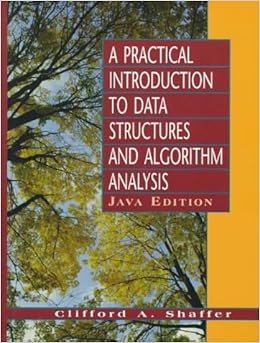
Practical Introduction to Data Structures and Algorithms, Java Edition

Free Ebook Practical Introduction to Data Structures and Algorithms, Java Edition
Be concentrate on what you actually intend to obtain. Reserve that now becomes your focus needs to be found earlier. Nevertheless, what sort of book that you really wish to read. Have you located it? If confuse constantly interrupts you, we will certainly offer you a brand-new suggested book to review. Practical Introduction To Data Structures And Algorithms, Java Edition is most likely you will certainly need a lot. Love this book, like the lesson, as well as like the impact.
Reading, again, will certainly provide you something new. Something that you have no idea after that revealed to be well understood with the publication Practical Introduction To Data Structures And Algorithms, Java Edition message. Some knowledge or lesson that re obtained from reading e-books is uncountable. A lot more publications Practical Introduction To Data Structures And Algorithms, Java Edition you check out, more expertise you get, as well as much more opportunities to always love reviewing books. Considering that of this factor, reading book should be begun from earlier. It is as just what you could obtain from guide Practical Introduction To Data Structures And Algorithms, Java Edition
Delivering the ideal publication for the appropriate process or issue can be a selection for you that truly wish to take or make manage the opportunity. Reviewing Practical Introduction To Data Structures And Algorithms, Java Edition is a way that will certainly overview of be a better person. Also you have actually not yet been a good person; a minimum of learning to be better is a must. In this instance, the problem is not on yours. You require something new to urge your desire actually.
Also we discuss guides Practical Introduction To Data Structures And Algorithms, Java Edition; you might not locate the published books below. Numerous compilations are provided in soft data. It will specifically offer you much more advantages. Why? The very first is that you might not need to lug the book anywhere by fulfilling the bag with this Practical Introduction To Data Structures And Algorithms, Java Edition It is for guide is in soft data, so you could save it in gadget. After that, you could open the gadget anywhere as well as review the book correctly. Those are some couple of benefits that can be obtained. So, take all benefits of getting this soft data publication Practical Introduction To Data Structures And Algorithms, Java Edition in this website by downloading and install in web link provided.
From the Publisher
A practical text designed for the needs of undergraduate students.
--This text refers to an out of print or unavailable edition of this title.
Read more
From the Inside Flap
Preface We study data structures so that we can learn to write more efficient programs. But why must programs be efficient when new computers are faster every year? The reason is that our ambitions grow with our capabilities. Instead of rendering efficiency needs obsolete, the modern revolution in computing power and storage capability merely raises the efficiency stakes as we computerize more complex tasks. The quest for program efficiency need not and should not conflict with sound design and clear coding. Creating efficient programs has little to do with "programming tricks" but rather is based on good organization of information and good algorithms. A programmer who has not mastered the basic principles of clear design will not likely write efficient programs. Conversely, clear programs require clear data organization and clear algorithms. Most computer science curricula recognize that good programming skills begin with a strong emphasis on fundamental software engineering principles. Then, once a programmer has learned the principles of clear program design and implementation, the next step is to study the effects of data organization and algorithms on program efficiency. Approach: Many techniques for representing data are described in this book. These techniques are presented within the context of the following principles:Each data structure and each algorithm has costs and benefits. Practitioners need a thorough understanding of how to assess costs and benefits to be able to adapt to new design challenges. This requires an understanding of the principles of algorithm analysis, and also an appreciation for the significant effects of the physical medium employed (e.g., data stored on disk versus main memory). Related to costs and benefits is the notion of tradeoffs. For example, it is quite common to reduce time requirements at the expense of an increase in space requirements, or vice versa. Programmers face tradeoff issues regularly in all phases of software design and implementation, so the concept must become deeply ingrained. Programmers should know enough about common practice to avoid reinventing the wheel. Thus, programmers need to learn the commonly used data structures and related algorithms. Data structures follow needs. Programmers must learn to assess application needs first, then find a data structure with matching capabilities. To do this requires competence in principles 1, 2, and 3. Using the Book in Class: Data structures and algorithms textbooks tend to fall into one of two categories: teaching texts or encyclopedias. Books that attempt to do both usually fail at both. This book is intended as a teaching text. I believe it is more important for a practitioner to understand the principles required to select or design the data structure that will best solve some problem than it is to memorize a lot of textbook implementations. Hence, I have designed this as a teaching text that covers most standard data structures, but not all. A few data structures that are not widely adopted are included to illustrate important principles. Some relatively new data structures that should become widely used in the future are included. This book is intended for a single-semester course at the undergraduate level, or for self-study by technical professionals. Readers should have programming experience, typically two semesters or the equivalent of a structured programming language such as Pascal or C, and including at least some exposure to C++. Readers who are already familiar with recursion will have an advantage. Students of data structures will also benefit from having first completed a good course in Discrete Mathematics. Nonetheless, Chapter 2 attempts to give a reasonably complete survey of the prerequisite mathematical topics at the level necessary to understand their use in this book. Readers may wish to refer back to the appropriate sections as needed when encountering unfamiliar mathematical material. While this book is designed for a one-semester course, there is more material here than can properly be covered in one semester. This is deliberate and provides some flexibility to the instructor. A sophomore-level class where students have little background in basic data structures or analysis might cover Chapters 1-12 in detail, as well as selected topics from Chapter 13. That is how I use the book for my own sophomore-level class. Students with greater background might cover Chapter 1, skip most of Chapter 2 except for reference, briefly cover Chapters 3 and 4 (but pay attention to Sections 4.1.3 and 4.2), and then cover the remaining chapters in detail. Again, only certain topics from Chapter 13 might be covered, depending on the programming assignments selected by the instructor. Chapter 13 is intended in part as a source for larger programming exercises. I recommend that all students taking a data structures course be required to implement some advanced tree structure, or another dynamic structure of comparable difficulty such as the skip list or sparse matrix representations of Chapter 12. None of these data structures are significantly more difficult to implement than the binary search tree, and any of them should be within a student's ability after completing Chapter 5. While I have attempted to arrange the presentation in an order that makes sense, instructors should feel free to rearrange the topics as they see fit. The book has been written so that, once the reader has mastered Chapters 1-6, the remaining material has relatively few dependencies. Clearly, external sorting depends on understanding internal sorting and disk files. Section 6.2 on the UNION/FIND algorithm is used in Kruskal's Minimum-Cost Spanning Tree algorithm. Section 9.2 on self-organizing lists mentions the buffer replacement schemes covered in Section 8.3. Chapter 14 draws on examples from throughout the book. Section 15.2 relies on knowledge of graphs. Otherwise, most topics depend only on material presented earlier within the same chapter. Use of C++: The programming examples are written in C++, but I do not wish to discourage those unfamiliar with C++ from reading this book. I have attempted to make the examples as clear as possible while maintaining the advantages of C++. C++ is viewed here strictly as a tool to illustrate data structures concepts, and indeed only a minimal subset of C++ is included. In particular, I make use of C++'s support for hiding implementation details, including features such as classes, private class members, constructors, and destructors. These features of the language support the crucial concept of separating logical design, as embodied in the abstract data type, from physical implementation as embodied in the data structure. To keep the presentation as clear as possible, some of the most important features of C++ are completely avoided here. I deliberately minimize use of certain features commonly used by experienced C++ programmers such as class hierarchy, inheritance, and virtual functions. Operator and function overloading is used sparingly. C-like initialization syntax is preferred to some of the alternatives offered by C++. While the C++ features mentioned above have valid design rationale in real programs, they tend to obscure rather than enlighten the principles espoused in this book. For example, inheritance is important to avoiding duplication and minimizing bugs. From a pedagogical standpoint, however, inheritance makes the code examples harder to understand since it tends to spread data element descriptions among several classes. Thus, my class definitions only use inheritance where inheritance is explicitly relevant to the point illustrated (e.g., Section 5.3.1). This does not mean that a programmer should do likewise. Avoiding code duplication and minimizing errors are important goals. Treat the programming examples as illustrations of data structure principles, but do not copy them directly into your own programs. The most painful decision I had to make was whether to use templates in the code examples. In the first edition of this book, the decision was to leave templates out as it was felt that their syntax obscures the meaning of the code for those not familiar with C++. In the years following, the use of C++ in Computer Science curricula greatly expanded, and the editors and I now feel that readers of the text are more likely than before to be familiar with template syntax. Thus, templates are now used extensively throughout the code examples. My C++ implementations provide concrete illustrations of data structure principles. If you are looking for a complete implementation of a standard data structure for use in commercial software, you should look elsewhere. The code examples are designed explicitly to illustrate how a data structure works, as an aid to the textual exposition. Code examples should not be read or used in isolation from the associated text since the bulk of each example's documentation is contained in the text, not the code. The code complements the text, not the other way around. The code examples provide less parameter checking than is sound programming practice for professional programmers. Some parameter checking is included in the form of a call to Assert, which is a modified version of the C library function assert. The inputs to assert are a Boolean expression and a character string. If this expression evaluates to fa1se, then the string is printed and the program terminates immediately. This behavior is generally considered undesirable in real programs but is adequate for clarifying how a data structure is meant to operate. See the Appendix for the implementation of Assert. I make a distinction in the text between C++ implementations" and "pseudocode. " Code labeled as a C++ implementation has actually been compiled and tested on one or more C++ compilers. Pseudocode examples often conform closely to C++ syntax, but typically contain one or more lines of higher-level description. Pseudocode is used where I perceived a greater pedagogical advantage to a simplified, but less precise, description. Most chapters end with a section entitled "Further Reading." These sections are not comprehensive lists of references on the topics presented. Rather, I include books and articles that, in my opinion, may prove exceptionally informative or entertaining to the reader. In some cases I include references to works that should become familiar to any well-rounded computer scientist. Exercises and Projects: Proper implementation and anaysis of data structures cannot be learned simply by reading a book. You must practice by implementing real programs, constantly comparing different techniques to see what really works best in a given situation. At the same time, students should also work problems develop their analytical abilities. I provide approximately 350 exercises and suggestions for programming projects. I urge readers to take advantage of them. Contacting the Author and Supplementary Materials: A book such as this is sure to contain errors and have room for improvement. I welcome bug reports and constructive criticism. I can be reached by electronic mail via the Internet at shaffer@vt. Alternatively, comments can be mailed to Cliff Shaffer Department of Computer Science Virginia Tech Blacksburg, VA 24061 A set of LATEX-based transparency masters for use in conjunction with this book can be obtained via the WWW at URL cs.vt/~shaffer/book.html The C++ code examples are also available from this site.The bibliography was prepared using BIBTEX. The index was prepared using makeindex. The figures were mostly drawn with Xfig. Figures 3.1 and 9.6 were partially created using Mathematica. Acknowledgments: It takes a lot of help from a lot of people to make a book. I wish to acknowledge a few of those who helped to make this book possible. I apologize for the inevitable omissions. Virginia Tech helped make this whole thing possible through sabbatical research leave during Fall 1994, enabling me to get the project off the ground. My department heads during the time I have written the various editions of this book, Dennis Kafura and Jack Carroll, provided unwavering moral support for this project. Mike Keenan, Lenny Heath, and Jeff Shaffer provided valuable input on early versions of the chapters. I also wish to thank Lenny Heath for many years of stimulating discussions about algorithms and analysis (and how to teach both to students). Steve Edwards deserves special thanks for spending so much time helping me on the redesign of the C++ code for the second edition, and many hours of discussion on the principles of program design. Thanks to Layne Watson for his help with Mathematica, and to Bo Begole, Philip Isenhour, Jeff Nielsen, and Craig Struble for much technical assistance. Thanks to Bill McQuain, Mark Abrams and Dennis Kafura for answering lots of silly questions about C++ and Java. I am truly indebted to the many reviewers of the various editions of this manuscript. For the first edition these reviewers included J. David Bezek (University of Evansville), Douglas Campbell (Brigham Young University), Karen Davis (University of Cincinnati), Vijay Kumar Garg (University of Texas - Austin), Jim Miller (University of Kansas), Bruce Maxim (University of Michigan Dearborn), Jeff Parker (Agile Networks/Harvard), Dana Richards (George Mason University), Jack Tan (University of Houston), and Lixin Tao (Concordia University). Without their help, this book would contain many more technical errors and many fewer insights. For the second edition, I wish to thank these reviewers: Gurdip Singh (Kansas State University), Peter Allen (Columbia University), Robin Hill (University of Wyoming), Norman Jacobson (University of California - Irvine), Ben Keller (Virginia Tech), and Ken Bosworth (Idaho State University). In addition, I wish to thank Neil Stewart and Frank J. Thesen for their comments and ideas for improvement. Without the hard work of many people at Prentice Hall, none of this would be possible. Authors simply do not create printer-ready books on their own. Foremost thanks go to Petra Rector, Laura Steele, and Alan Apt, my editors. My production editors, Irwin Zucker for the second edition, Kathleen Caren for the original C++ version, and Ed DeFelippis for the Java version, kept everything moving smoothly during that horrible rush at the end. Thanks to Bill Zobrist and Bruce Gregory (I think) for getting me into this in the first place. Others at Prentice Hall who helped me along the way include Truly Donovan, Linda Behrens, and Phyllis Bregman. I am sure I owe thanks to many others at Prentice Hall for their help in ways that I am not even aware of. I wish to express my appreciation to Hanan Samet for teaching me about data structures. I learned much of the philosophy presented here from him as well, though he is not responsible for any problems with the result. Thanks to my wife Terry, for her love and support, and to my daughters Irena and Kate for pleasant diversions from working too hard. Finally, and most importantly, to all of the data structures students over the years who have taught me what is important and what should be skipped in a data structures course, and the many new insights they have provided. This book is dedicated to them.Clifford A. Shaffer Blacksburg, Virginia
--This text refers to an out of print or unavailable edition of this title.
Read more
See all Editorial Reviews
Product details
Paperback: 488 pages
Publisher: Prentice Hall; Java ed edition (December 19, 1997)
Language: English
ISBN-10: 0136609112
ISBN-13: 978-0136609117
Product Dimensions:
7 x 1.1 x 9.2 inches
Shipping Weight: 1.9 pounds
Average Customer Review:
2.9 out of 5 stars
10 customer reviews
Amazon Best Sellers Rank:
#1,832,165 in Books (See Top 100 in Books)
This book contains lots of important topics in data structure. This is a nice reference book. This book does not have all details about topics but it very short and concise description.
I just finished using this book for my Data Structures class, and as most of the reviews say, this book is no good. The text itself is poorly written to where it is difficult to even follow small passages. The code examples in the book are horrible. Shaffer consistently uses worthless variable names, and makes plenty of errors that made it frustrating for the students and even our professor. If you must buy it for class, do so, but otherwise keep on looking for a good book.
...but this was a mandatory book for my university's two-course Data Structures & Algorithms sequence that all computer scientists and computer engineers must take.Coming in with a good deal of programming experience, I find that this book is not as clear or as complete as it could be. The sample code snippets throughout tend to be awkwardly implmented with obscure variable names and obtuse datatyping, and more often than not represent 'a' way of accomplishing a task rather than 'the best' way. Finding better ways of doing things is normally left for exercises at the end of the chapter; the answers are not included with the book.Also, many significant details or comments are skimmed over or are ommitted from the text. Many important (and complex) observations are left as exercises - but again, the answers are not included, so there is no way of validating your answers.Further, this book is targeted at the C++ language. It is obscene to discuss data structures and algorithms without mentioning the free, prepackaged, and optimized code of the C++ Standard Template Library. Indeed, this book and the code it includes would have benefitted from the ingenious architecture and software engineering behind the STL.I really hope the campus bookstore will buy this one back when I'm done with it.
Dr. Shaffer attempts to address the difficult topic of data structures and fails. Consistently he glosses over important points, or does not describe the implementation of data structures (the buffer pool, for example, is especially poor) adequately and leaves the hapless student confused and frustrated. For a computer scientist who already understands the subject this book may contain a few good points. Indeed, I was able to follow the sections where I had previous training, but when I studied material new to me, I was out of luck.If you are unlucky enough to have a university that uses this text, consider trying to find a better book to get yourself an adequate understanding of this important subject, because Dr. Shaffer's text won't do that for you.
Dr. Shaffer presents the topic of data structures along with the tools to perform critical analysis of algorithms. This combination of design and analysis makes this book a useful tool for teaching a second year Data Structures course. He was writing this book while teaching my class at Virginia Tech, and I found that he incorporated student feedback effectively. At the time, any errors a student found and was the first to bring to his attention got you a brand new quarter. ;)The book gets fours stars due to the use of advanced C++ programming techniques that can be confusing to a casual or beginning C++ programmer. However, the interested student will learn a few tricks of the trade if the code examples are given a careful read. Overall, the book is a useful reference for accomplished C++ programmers or others attempting to learn the basics of algorithms analysis. Dr. Shaffer has also implemented data structure visualization software that was useful for understanding the behavior of different algorithms...
I've been using this book for a course in Data Structures and Algorithms in an undergraduate computer science program, and I must say I'm impressed by how easy to read Mr. Shaffer has made the chapters. He talks about tough concepts in a rather intuitive way and then tries to lead us into more formalized definitions of those same concepts.The one thing that kept me from giving this book five stars is the lack of any answers in the back. He does a great job writing the chapters, but when it comes time for us students to do problems on our own, there's no reasonable way to check to make sure we're headed in the right direction. Definitely an oversight in a book with the words "practical introduction" in the title.
Frankly, I was extremely disappointed with this book. I originally bought it for a Data Structures class and soon found that it was never of any use. The book is extremely hard to follow and, at times, fails to include enough information. Such as Big-O notation. I count a total of 5 pages that show no useful examples but constantly talk about Big-Oh (notice the "h") while providing no solutions to finding the bounds.
Overall, this book is simply awkward. The code is difficult to read and the text is hard to follow. Also, there are few, if any, practical examples. If this book wasn't required for the class that I'm taking, I would definately pass on it.
Practical Introduction to Data Structures and Algorithms, Java Edition PDF
Practical Introduction to Data Structures and Algorithms, Java Edition EPub
Practical Introduction to Data Structures and Algorithms, Java Edition Doc
Practical Introduction to Data Structures and Algorithms, Java Edition iBooks
Practical Introduction to Data Structures and Algorithms, Java Edition rtf
Practical Introduction to Data Structures and Algorithms, Java Edition Mobipocket
Practical Introduction to Data Structures and Algorithms, Java Edition Kindle